Alex Zah
After an argument, the fight can be over while your body still feels like it is happening. Your mind replays the exact sentence. You imagine the better comeback. You pick up your phone, put it down, pick it up again.
That does not mean you are broken or dramatic. It usually means the conflict still has a grip on attention, breath, posture, and the urge to respond.
If anger is still moving through your hands, jaw, chest, or urge to act, try one of these safe somatic exercises for anger before returning to the conversation.
Why arguments keep echoing
An argument is not only a thought problem. It is also a state problem: attention narrows, muscles brace, the breath changes, and the brain keeps searching for threat, repair, proof, or control.

The replay loop matters. Research on rumination after provocation suggests that stewing on an insult or conflict can keep anger active and make later reactions sharper. In everyday language: replaying the argument often feels like processing, but it can keep the body in the argument longer.
If the replay continues after the immediate reset, compare the different jobs performed by apps for overthinking before adding another generic calming tool.
So the first move is not to solve the relationship. It is to stop adding fuel to the state.
About the 90-second idea
The popular “90-second rule” is useful as a practice frame: pause, let the first wave move through, and avoid feeding it with replay. But it should not be treated as a precise scientific guarantee that every emotional reaction clears in exactly 90 seconds.
Some arguments settle quickly. Some take longer because the topic is serious, the relationship matters, or the conflict connects to older patterns. The point is not to force calm on a timer. The point is to create enough space that your next move is chosen, not discharged.
The 90-second reset
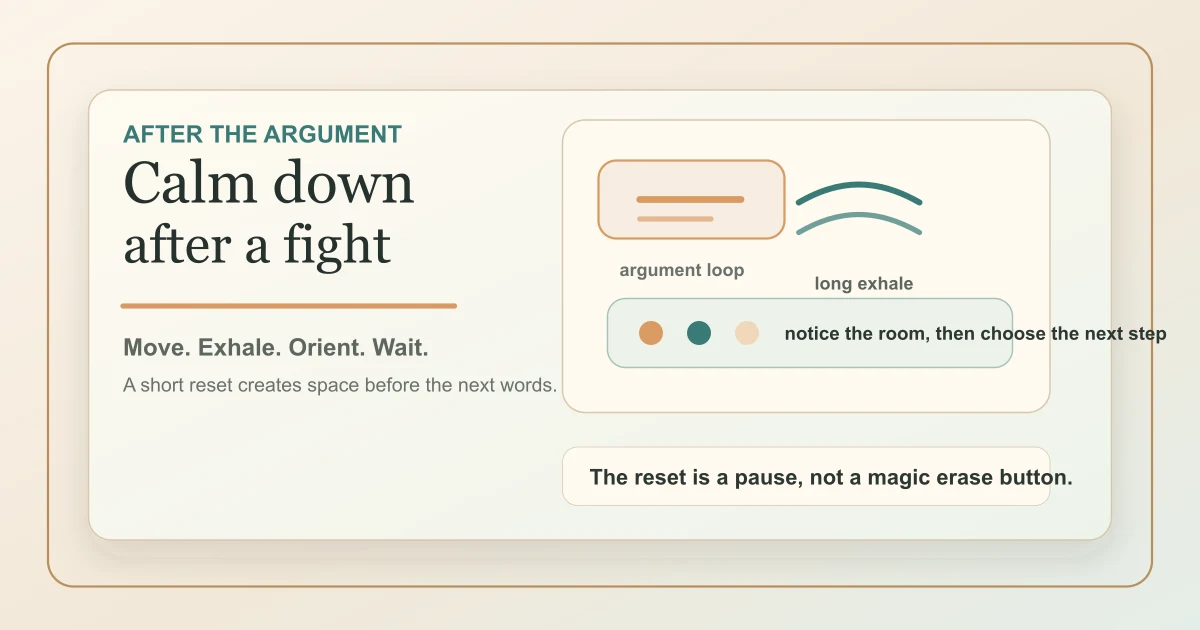
Use this sequence before sending the message, returning to the room, or deciding what the argument “means.”

1. Change the physical cue
Stand up if you were sitting. Sit down if you were pacing. Walk to different light, put both feet on the floor, or touch a stable surface. You are giving the body a new cue: the argument is not still happening in the same exact place.
2. Lengthen the exhale
Take six easy exhales that are longer than the inhales. Do not strain for an eight-second breath if that feels forced. The goal is a clear signal of downshifting, not a perfect breathing performance.
Brief structured breathing research supports the idea that short daily breath practices can influence mood and physiological arousal. That is different from promising instant calm, but it makes the breath a reasonable tool after a conflict spike.
3. Label the state
Use one plain phrase: “I feel angry,” “I feel embarrassed,” “I feel scared,” or “I feel defensive.” Affect-labeling research suggests that putting feelings into words can change how emotional material is processed. In practice, it turns a storm into something you can relate to.
4. Orient to the room
Name three things you can see, two sounds, and one physical contact point. This brings attention out of the imagined courtroom and back to the room you are actually in.
5. Wait before the next words
Give yourself ten more seconds. Ask: “Do I need to repair, clarify, pause, or protect myself?” A calmer next sentence is usually more useful than the fastest next sentence.
Safety note: if the argument involved threat, coercion, violence, self-harm risk, or fear for anyone’s safety, do not use this as a relationship repair script. Get distance and support first.
What not to do right away
Do not keep texting while activated. A useful message can wait until your body is no longer trying to win, defend, or escape.
Do not replay the argument as proof gathering. If you need to make a note, write one neutral line: “I want to talk about the dinner comment tomorrow.” Then stop.
Do not use alcohol or scrolling as the whole reset. They can distract you from the state, but they rarely help you choose the next relational move clearly.
When to come back to the conversation
Come back when you can say one sentence without needing it to win the whole case. A simple version is: “I want to talk about this, but I needed a minute to calm down first.”

If you are still rehearsing a speech, you are probably not ready. Try a longer reset, a walk, or a self-distanced question: “What would I want a kind observer to understand about both people here?”
How NerveWindow uses this idea
NerveWindow turns this into a state-matched routine. Instead of asking you to remember every technique while activated, it helps you identify whether you are wired, shut down, or somewhere in between, then gives you a short reset matched to that state.
It is not therapy, medical care, or crisis support. It is a self-guided tool for everyday conflict aftermath when you want a structured next step. See the 90-Second Reset.
FAQ
What should I do immediately after an argument?
Step away if it is safe, change your posture or room, lengthen your exhale, orient to what is physically around you, and wait before texting or continuing the conversation.
Is the 90-second reset a proven biological rule?
No. It is best treated as a useful pause container, not a guaranteed biological law. Many people need more than one short cycle, especially if they keep replaying the fight.
Should I text the other person right away?
Usually not. After an argument, activation can narrow attention and make messages sharper than intended. Regulate first, then decide what actually needs to be said.
What if I still feel activated after 90 seconds?
Repeat the sequence more gently or switch to a longer reset. If the conflict feels unsafe, threatening, or connected to harm, prioritize safety and support over self-guided regulation.
Short takeaway
The reset is simple: move, exhale, label, orient, wait. It will not solve the whole relationship, but it can stop the argument from controlling your next words.
The 90-Second Reset After a Fight. $27 lifetime. 30-day refund.