 Alex Zah

Method and evidence limits
This review compares what Moodfit and NerveWindow each say about themselves — the stated job, the access model, published pricing, and public disclosures — against facts NerveWindow can confirm directly about its own product. It does not score health outcomes for either app, and app store ratings are not evidence that a tool works. A vendor's own marketing claim is not proof of an effect; it is simply what the company states about its product.
- Official vendor claims — statements Moodfit makes about its own app, drawn from its own site and purchase-options page.
- Storefront facts — details taken from the iOS and Android app store listings.
- NerveWindow facts — pricing, access, and mechanics we can state directly because we built the product.
- Editorial inference — reasonable conclusions drawn where no official figure exists, marked as such.
What Moodfit currently offers
Moodfit is a mental-health toolkit app available on iOS and Android that bundles several self-help approaches into one dashboard. The core pieces are mood tracking, CBT-style exercises (the kind of structured thought-work associated with cognitive behavioral therapy), goal setting, and educational content, all accessible from a single home screen. Rather than being built around one exercise, it's designed as a place you return to repeatedly, logging your mood and working through tools over weeks or months.

That breadth is the app's identifying feature. Instead of picking one method and going deep, Moodfit gives you a shelf of options and lets you choose what to use on a given day — a tracker for one mood dip, a CBT worksheet for a recurring thought pattern, an article for background reading, a goal you're building toward over time. For someone who wants a full self-help dashboard rather than a single tool, that range is genuinely useful.
The trade-off is that using Moodfit well takes some ongoing effort. Value tends to come from consistent logging and returning to the tools over time, not from opening the app once during a hard moment and getting an immediate, matched response. It's built as a toolkit to build a practice with, not a single-purpose reset button.
Access, pricing, and cancellation
Moodfit's core features are free to use on both iOS and Android. The full toolkit and education content sit behind a paid premium tier, and Moodfit prices that tier unusually: instead of an auto-renewing subscription, it sells one-time passes. Based on Moodfit's own purchase-options page (checked 2026-09-10), a 1-year pass is $35.99 (frequently discounted to $19.99–$29.99), a pass covering two years for the price of one is $39.99, and a lifetime pass is $119.99 (frequently discounted to $89.99).
Because these are one-time, non-auto-renewing purchases rather than a subscription, there is no recurring charge to cancel. A 1-year or 2-year pass simply expires at the end of its term with nothing further billed; the lifetime pass, as the name suggests, does not expire. Purchases run through Apple's or Google's standard in-app purchase flow, so refund requests follow each platform's normal purchase-refund process rather than an in-app cancellation button.
Privacy details worth reading
As with most apps in this category, Moodfit collects account information and the usage data needed to run its tracking and goal features — mood entries, tool usage, and progress toward goals are the kind of data a toolkit like this needs to function. We have not independently verified Moodfit's data retention period or exactly which third parties, if any, receive aggregated or identified data.
If you plan to log detailed mood entries or personal notes, it's worth reading Moodfit's current privacy policy directly on its site or in the app store listing before you start, rather than assuming a particular standard. That's true of any app that asks you to track sensitive personal information over time, not a claim specific to Moodfit.
Moodfit's clearest fit
Moodfit earns its place for a specific kind of user: someone who wants an ongoing self-help practice, not a single fast action.
- You want one dashboard for several tools. Mood tracking, CBT-style worksheets, goals, and education content in one place suits someone who doesn't want to juggle separate apps for each.
- You're building a long-term habit, not looking for instant relief. The app rewards consistent use over weeks or months rather than a single high-value session.
- You want to avoid a subscription. One-time, non-auto-renewing passes are unusually buyer-friendly in a category dominated by recurring billing, and that's a genuine strength worth crediting.
- You want to try before you commit. The free tier is substantial enough to test the general approach before deciding whether the paid pass is worth it.
Where the model may not fit
The same breadth that makes Moodfit useful for some people makes it a weaker fit for others.

- Breadth over depth. A dashboard of many tools means no single tool gets the depth of a purpose-built app; you may need to explore before finding what works for you.
- Not built for right now. Moodfit is designed around ongoing logging and tool use, not a fast, matched response to how you feel in the moment.
- Full value sits behind the paid pass. The complete toolkit and education content require a premium purchase, even though pricing is one-time rather than recurring.
- Requires some navigation. Choosing which tool fits your current mood is left to you, which can be a hurdle on a day when deciding feels hard.
Moodfit vs NerveWindow

Core job
A broad self-help toolkit — mood tracking, CBT-style tools, goal setting, and education — in one dashboard.
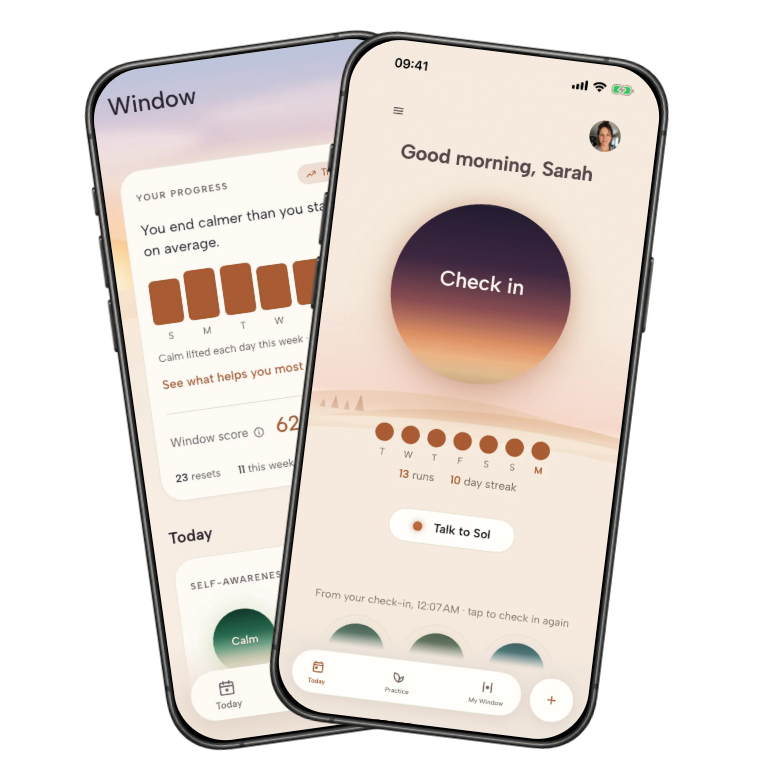
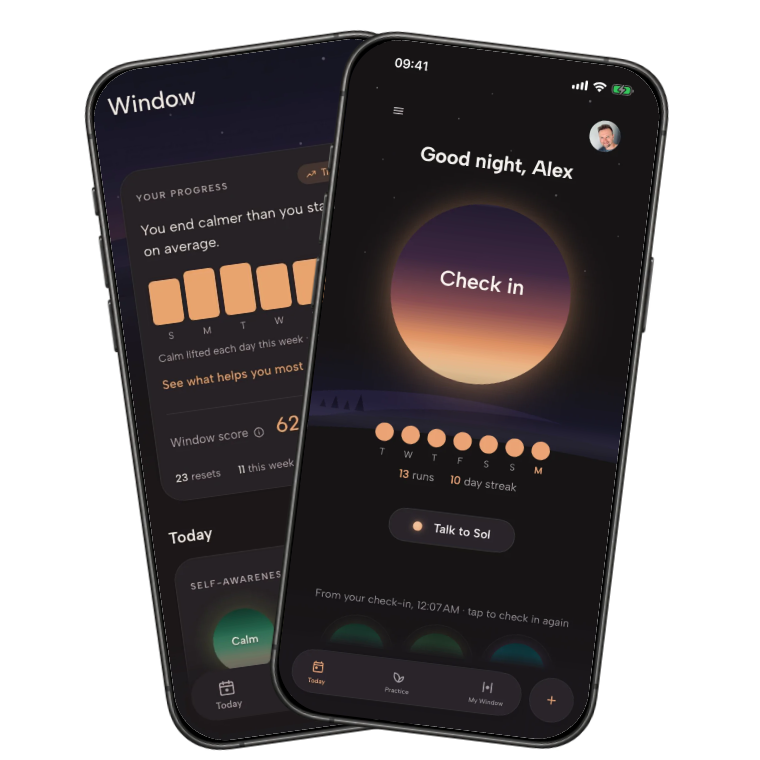
One matched regulation exercise for your current state, done in about seven minutes.
Access
iOS and Android app; free core features, premium unlocked by in-app purchase.
Runs in the browser; account-gated, no app store install required.
Choice model
You browse the dashboard and pick which tool to use yourself.
You describe your state; it selects the one matching exercise for you.
Content depth
Wide toolkit — tracking, CBT worksheets, goals, articles — breadth over depth in any one area.
Narrow and deep on one job: matching state to action, not a content library to browse.
Payment model
One-time, non-auto-renewing passes: $35.99 (1 year), $39.99 (2 years), $119.99 (lifetime), often discounted.
$27 one-time (Basic) or $67 one-time (Pro). No subscription, ever.
Best fit
Someone who wants an ongoing self-help toolkit and doesn't mind exploring their options.
Someone who wants a fast, matched action right now without a dashboard to learn first.
When NerveWindow is the better alternative
If what you actually want, most days, is relief for how you feel in this moment rather than a toolkit to build a practice with, NerveWindow is built for that specific job instead. You can also try the underlying approach without installing anything through NerveWindow's free brain dump tool, which gives a small taste of the state-matching idea before you decide whether to pay for either product.
- You want one action, not a dashboard. No tracking history to review or tools to choose between — just the exercise matched to your state right now.
- You don't want to build a logging habit first. NerveWindow doesn't ask you to track mood over time before it's useful; it works the first time you open it.
- You want the whole thing done in about seven minutes. One exercise, start to finish, rather than an open-ended session with a toolkit.
Who should stay with Moodfit
If you want a broad, one-time-purchase self-help toolkit for ongoing CBT-style work — not just in-the-moment regulation — Moodfit is a genuinely reasonable choice, and its non-subscription pricing model deserves real credit in a category full of recurring billing. Someone building a longer-term practice around tracking, structured thought-work, and goal setting will get more out of Moodfit's range than out of a single-exercise tool. And the substantial free tier means you can find that out without paying anything first.
Other alternatives by job
Moodfit and NerveWindow solve different jobs, and neither is the right fit for everyone. A few other options worth knowing about, by the specific job each is built for:
- Rootd — for acute-stress-moment tools rather than a broad self-help dashboard; see our Rootd review.
- Balance — for a large guided-meditation library rather than a CBT-style toolkit; see our Balance review.
- NerveWindow — for one matched exercise for your current state, done in minutes, with no dashboard.
- For the full comparison across every option we've reviewed, see our roundup of nervous-system regulation apps.
What to check before choosing
Before you pay for Moodfit, NerveWindow, or anything else in this category, take a few minutes to check these yourself rather than relying on any review, including this one:
- Confirm the current price on the actual payment screen. Discounts change, and the price you see in an app store listing or on a purchase page can differ from what's live right now.
- Check whether it's one-time or recurring. Moodfit's premium passes don't auto-renew, but confirm that's still true and understand exactly what each pass term covers.
- Look up the refund window. Refunds on in-app purchases follow Apple's or Google's standard policy, not a custom one set by the app — know that window before you buy.
- Confirm it runs on your platform. Moodfit is iOS and Android only; NerveWindow runs in any browser, which matters if you want to use it on a computer as well as a phone.
FAQ
Was Moodfit tested for this review?
No. We did not install or use Moodfit to measure outcomes. This review compares Moodfit's stated job, access model, published pricing, and public disclosures against NerveWindow's own facts. It is not a test of effectiveness for either product.
Is Moodfit free?
The core features are free to use. A paid premium tier unlocks the full toolkit and education content, sold as one-time, non-auto-renewing passes rather than a subscription. As of the source checked on 2026-09-10, a 1-year pass is $35.99 (often discounted to $19.99–$29.99), a 2-years-for-the-price-of-one pass is $39.99, and a lifetime pass is $119.99 (often discounted to $89.99).
How much does Moodfit cost?
Moodfit's premium passes are $35.99 for one year, $39.99 for two years, and $119.99 for lifetime access, based on the app's own purchase-options page checked on 2026-09-10. These are frequently discounted, and none of them renew automatically — you pay once per pass and it simply expires or, for the lifetime option, never does.
What is the main difference between Moodfit and NerveWindow?
Moodfit is a broad self-help dashboard: mood tracking, CBT-style tools, goal setting, and education, meant to be used and reviewed over time. NerveWindow asks what state you're in right now and gives you one matching exercise, done in about seven minutes, with no dashboard to browse first.
Prefer a short practice chosen around what is happening now?