Alex Zah
A good regulation practice has two layers. The first layer is immediate: you do the practice and your state changes. Your breath slows. Your shoulders drop. You can answer the message without sending the version you would regret.
The second layer is quieter. After repetition, some parts of the practice become easier to find in ordinary life. You notice the jaw clench before the argument. You catch the scroll before it eats the evening. You remember that flatness may need gentle activation before stillness.
This page is educational. It is not a diagnosis, medical advice, therapy, crisis care, or a guarantee that self-guided practice will change your baseline. If your reactions are intense, trauma-linked, medically concerning, or disrupting daily life, get qualified support.
What carryover actually means
Carryover is not the same as a permanent effect. It means something learned in one context becomes easier to access in another context.
If you practice noticing state in the app, carryover is noticing state in the kitchen, in a meeting, or while staring at a blank task. If you practice returning from activation, carryover is remembering one return move before the conversation escalates. If you practice upshifting from flatness, carryover is recognizing that you need light, motion, or contact before trying to think harder.
That is less dramatic than “the training keeps working after you stop.” It is also more honest, and more useful.

Three things that are most likely to stick
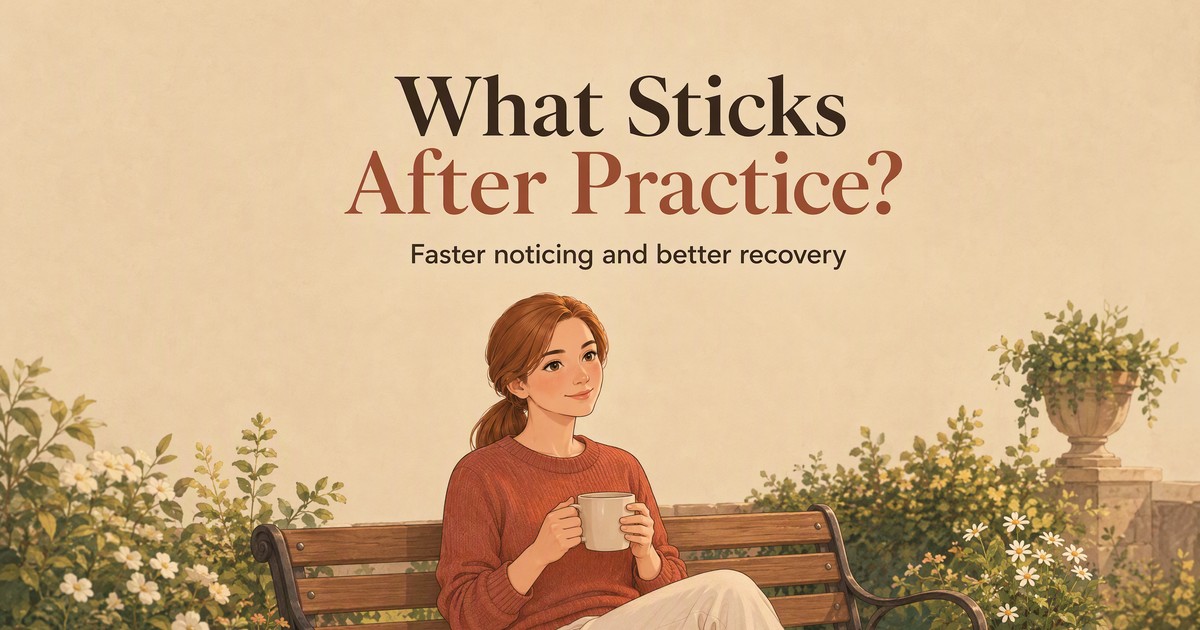
Earlier noticing
You recognize activation, shutdown, or workable middle sooner.
A return path
You have one or two reliable moves for the state you are in.
More choice
There is a small pause where the old reaction used to be automatic.
These are not medical outcomes. They are practical skills. But practical skills matter, especially when the stressor is ordinary: emails, conflict, fatigue, noise, deadlines, screens, transitions.
Why repetition matters
The body adapts to repeated demand. Stress research often uses the language of allostasis: the system changes in response to load, and repeated load without enough recovery can create wear and tear.
Regulation practice uses a gentler version of the same logic: small demand, clear return, repeated enough that the return path becomes familiar. That is why the recovery portion matters. You are not only trying to feel better during a session. You are rehearsing what coming back feels like.
Heart-rate-variability biofeedback research is one useful comparison. It does not prove every app practice changes your baseline, but it does show why regular breath-linked feedback and recovery practice can matter for autonomic regulation.
Why state-matching matters
Carryover is harder when every state gets the same tool.
If you are above your window, you may need downshifting: longer exhales, orienting, slower movement, lower stimulation. If you are below your window, you may need gentle upshifting: standing, opening light, naming objects, contacting a safe person, or taking one small physical action.
Brief structured breathing practices have evidence for reducing physiological arousal for some people. But the safest takeaway is not “breathwork fixes everything.” The takeaway is that simple, repeatable practices can influence state, and the practice still needs to match the person and moment.
What does not carry over well
- One intense session. It can feel meaningful, but carryover usually needs repetition.
- Generic calm practice. Calm is one state, not the whole range.
- Over-monitoring. Tracking every sensation can become another loop.
- Forcing exposure. Overwhelming yourself is not the same as building a return path.
- Outsourcing all awareness to an app. The app should train attention, not replace it.
A realistic practice shape
For carryover, keep it small enough to repeat.
Before practice: name the state. Above, below, or inside your window.
During practice: use one matched tool. Do not stack five tools unless you genuinely need to.
After practice: notice the smallest change. Breath, posture, eyes, temperature, urge, thought speed, ability to choose.
Later that day: look for one ordinary moment where the same pattern appears. That is where practice becomes a life skill.
Where NerveWindow Pro fits
NerveWindow Pro is built as a self-guided practice container: state check first, matched routine second, repetition over time. It is not a clinical plan, and it should not be treated as a replacement for human support when human support is needed.
The useful promise is smaller and sturdier: practice the return path often enough that it becomes easier to find when the day gets real.
FAQ
Does nervous system practice keep working after you stop?
Some effects may carry into daily life as learned skills, but this page does not claim a fixed carryover window. Carryover depends on the person, the practice, and the situation.
What is the most realistic carryover from daily practice?
Faster noticing, a clearer return path, and more choice during ordinary stress. That is different from permanent calm.
How much practice is enough?
There is no universal dose. Short, consistent, state-matched practice is usually more realistic than occasional long sessions, but it should not replace professional support when support is needed.
Can NerveWindow Pro change my baseline?
NerveWindow Pro can help you repeat state-matched routines. It is not therapy, medical care, crisis care, or a guaranteed baseline-change program.
The short takeaway
The thing that sticks after nervous system practice is not a permanent state. It is a practiced relationship to state: notice sooner, choose better, recover more deliberately, and repeat until the return path is easier to find.
NerveWindow Pro supports state-matched daily practice. $67 lifetime.