 Alex Zah
The physiological sigh is a short breathing pattern: two inhales followed by a longer exhale. It can be useful when your body is keyed up, breathing feels shallow, or you need a quick body-led cue before your mind can settle.
Physiological sigh vs cyclic sighing
People often use these terms together, but there is a small difference. A physiological sigh usually means one breath pattern: inhale, small second inhale, long exhale. Cyclic sighing means repeating that pattern as a practice.

That distinction matters for SEO, science, and common sense. The Stanford paper studied daily five-minute breathing practices over a month. It supports the idea that repeated cyclic sighing can influence mood and physiological arousal in that study context. It does not prove that one dramatic breath fixes every nervous system state.
How to do the physiological sigh
Keep it smaller than the social-media version. The goal is not to perform a huge breath. The goal is to give your body a clear, gentle cue.
- 1. InhaleTake a normal inhale through the nose.
- 2. Top offBefore exhaling, take a small second inhale.
- 3. ExhaleLet the exhale be longer and slower than the inhale.

Start with one to three rounds. If it feels useful, continue for a few minutes. If you feel dizzy, panicky, numb, unsafe, or worse, stop and choose a simpler grounding tool.

What the Stanford study found
In 2023, Melis Balban and colleagues published a randomized remote study in Cell Reports Medicine. Participants practiced one of four five-minute routines each day for one month: mindfulness meditation, box breathing, cyclic hyperventilation, or cyclic sighing.
All groups improved over the month. The cyclic sighing group showed the strongest daily improvement in positive affect and a larger reduction in resting respiratory rate than the mindfulness meditation group. That is a meaningful result, especially because the intervention was brief and low-tech.
The careful claim is narrow: repeated cyclic sighing was associated with better mood and lower respiratory arousal in this study. It is not proof that breathwork treats anxiety disorders, trauma, panic, or medical breathing problems.
Why the exhale may matter
A sigh is not just a deep breath. Research on sighing describes it as part of breathing regulation, and physiological sighs may help restore variability in breathing after periods of shallow or constrained respiration. The second inhale may change lung mechanics and air exchange; the longer exhale may also give the body a downshift cue.
That does not mean you should force the breath. For many people, the most useful version is ordinary and quiet: a normal inhale, a small top-off inhale, and an unforced exhale.
When to use it
The physiological sigh is most likely to fit activation: the state where the body feels wired, tight, shallow-breathed, or ready to react.
- Your chest feels tight or your breath is shallow.
- Your mind is racing before a call, meeting, or hard message.
- You are irritated, braced, or over-alert.
- You notice yourself holding your breath at the screen.
It pairs naturally with the broader state-matched breathwork idea and the 7-minute nervous system reset.
If you want guided breathing rather than a single technique, compare the best breathwork apps by use case before choosing a library, timer, or state-matched tool. You can also read our Breathwrk review and Othership review.
When not to use it
If you feel flat, far away, foggy, or collapsed, breath focus may not be the best first move. For some people in a shutdown-style state, repeated long exhales can feel like more collapse rather than more regulation. In that case, try opening your eyes, orienting to the room, standing up, or using gentle movement before breathwork.

Avoid intense breathwork, hyperventilation, or breath holds in water, while driving, while standing somewhere unsafe, or anywhere fainting would be dangerous. If you are pregnant, have cardiovascular, respiratory, seizure, fainting, panic, trauma, or serious mental-health concerns, use professional guidance before experimenting with intense practices.
Safety note
The physiological sigh is a self-regulation tool, not a treatment plan. If breathing practice brings chest pain, faintness, panic, traumatic memories, self-harm thoughts, or a sense of danger, stop and use appropriate professional or emergency support.
How NerveWindow uses it
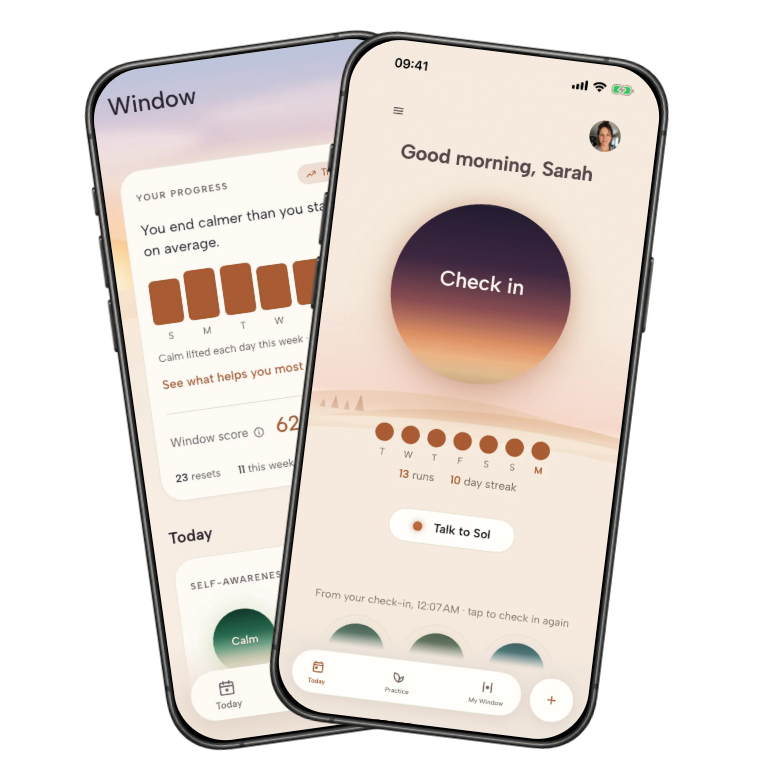
NerveWindow does not treat the physiological sigh as a universal fix. It uses state-matching. If your check-in suggests activation, it may offer a sigh-based or longer-exhale reset. If your state looks more like shutdown, it points toward orientation, sensory contact, or movement instead.
That is the important design choice: know the state first, then pick the routine. See how NerveWindow works.
FAQ
What is the physiological sigh?
It is a breathing pattern with two inhales followed by a longer exhale: a normal inhale, a small second top-off inhale, then a gentle exhale.
Did the Stanford study prove it instantly calms anxiety?
No. The study supports repeated five-minute cyclic sighing over one month as a brief practice that improved mood and reduced respiratory rate in that study context. It does not prove instant anxiety relief for everyone.
How many rounds should I do?
Start with one to three rounds. If it feels helpful, continue gently for a few minutes. More force is not better.
When should I not use it?
Do not force it if you feel dizzy, panicky, numb, unsafe, or medically unwell. Avoid intense breathwork or breath holds in unsafe settings, especially in water or while driving.
Short takeaway
The physiological sigh is a useful small tool for activation: inhale, small top-off inhale, long exhale. The best evidence is for repeated cyclic sighing practice, not a guaranteed one-breath cure. Use it gently, match it to your state, and stop if your body says no.
NerveWindow matches the routine to your state: breathwork when it fits, other tools when it does not. $27 lifetime.