Alex Zah
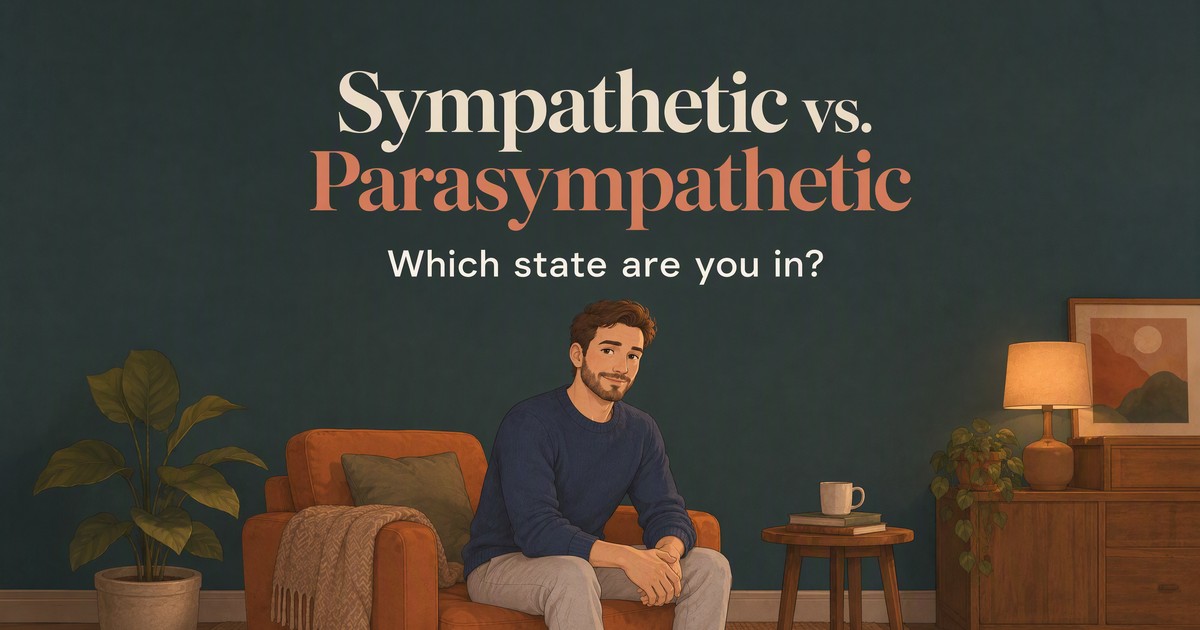
Sympathetic and parasympathetic are two broad parts of the autonomic nervous system. The problem is that internet language often turns them into "bad stress" and "good calm." Real bodies are more nuanced.
Sympathetic activation
Sympathetic activation prepares the body for action. In healthy doses, it supports focus, effort, exercise, and challenge. In excess, it can feel like racing thoughts, tight chest, irritability, jaw tension, shallow breathing, urgency, or startle.
For this state, downshift tools can help: longer exhales, a gentle physiological sigh, walking, orienting, or reducing input.
If activation is showing up mainly as anger, choose from these low-intensity somatic anger exercises instead of forcing stillness.

Parasympathetic recovery
Parasympathetic recovery is the state people usually mean when they say "rest and digest." It can feel like steadier breath, better digestion, more flexible attention, and enough safety to pause.
Practices like coherence breathing, quiet routines, and slow transitions can support this state for some people. But forcing calm can become another stressor.
Shutdown is different from recovery
A flat, foggy, collapsed, or far-away state is not the same as restorative rest. In polyvagal language, people often call this dorsal vagal shutdown. In defense-cascade language, it may resemble freeze or immobility patterns.
For shutdown, the first move is often not deeper relaxation. It may be orientation, light movement, sensory contact, food, water, warmth, or supportive connection. See the dorsal shutdown guide for more detail.
How to check your state
Ask three quick questions. First: is my body high energy or low energy? Second: do I feel present or far away? Third: would more stillness help, or would a small movement help more?
These questions are not diagnostic. They are practical. They help you avoid using the same calming tool for every state.
Why state matching matters
A wired body may benefit from longer exhales. A flat body may need eyes-open orientation. A scattered but fairly steady body may benefit from rhythm. The right tool is not the trendiest tool; it is the tool that fits the current pattern.
This is the design idea behind NerveWindow: check the state, then choose the routine.
Safety note
Autonomic language is a map, not a diagnosis. If symptoms are severe, persistent, medically confusing, trauma-linked, unsafe, or connected to self-harm thoughts, use professional or emergency support.
FAQ
Is sympathetic activation bad?
No. Sympathetic activation is necessary for effort, focus, movement, and challenge. It becomes a problem when you cannot come down or when activation no longer fits the situation.
Is parasympathetic always good?
No. Healthy recovery is useful, but shutdown-style low energy is not the same as restorative rest.
What state should I aim for?
Aim for flexibility: enough activation for action, enough settling for recovery, and enough awareness to shift when needed.
What is the first tool to try?
If wired, try gentle downshifting. If flat, orient and move. If steady but scattered, try rhythm or a short routine.
Short takeaway
Sympathetic and parasympathetic are useful only if they help you choose the next tool. Wired, steady, and flat states need different support. Start by naming the state.
NerveWindow checks the state first, then gives you the matching routine. $27 lifetime.