Alex Zah
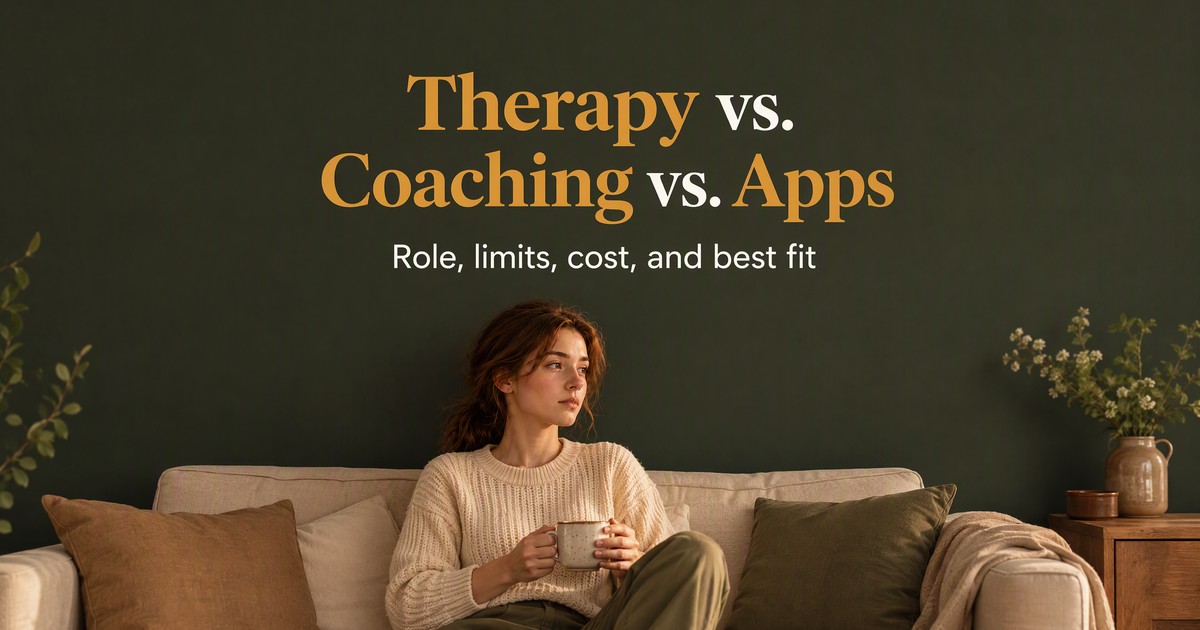
Therapy, coaching, and self-regulation apps all live near the same messy human territory: stress, emotions, patterns, choices, and the body’s response to pressure. That overlap is why they get confused.
But they are not the same tool. The cleanest way to choose is not “which one is best?” It is: what job do you need done?
The quick fit guide

| Support layer | Best fit | Not a fit for |
|---|---|---|
| Therapy | Licensed mental health care, trauma-informed support, grief, relationship patterns, diagnosis-related treatment planning, and symptoms that interfere with daily life. | Replacing emergency support, quick performance strategy, or a daily app-style practice container. |
| Coaching | Goals, decisions, leadership, accountability, identity shifts, and turning insight into action when the client is stable enough for that work. | Diagnosis, mental health treatment, trauma processing outside scope, or crisis care. |
| Self-regulation app | Low-friction daily practice, state awareness, breath/grounding/orientation tools, and between-session support. | Licensed care, diagnosis, treatment, relational containment, or personalized clinical judgment. |

What therapy does best
Therapy is the right layer when the work needs qualified mental health care. The National Institute of Mental Health describes psychotherapy as a range of treatments that help people identify and change troubling emotions, thoughts, and behaviors, usually with a licensed mental health professional or in a group setting.
That matters. Therapy is not just advice. It can include assessment, treatment planning, trauma-informed work, relationship patterns, grief, anxiety or depression symptoms, medication coordination with other providers, and the therapeutic relationship itself as part of the change process.
Therapy is usually the first place to look if your symptoms feel intense, unsafe, persistent, or disruptive to sleep, work, relationships, or basic functioning. If there is immediate danger or a risk of harm, use local emergency or crisis support rather than any app or article.
The tradeoff is practical. Therapy can be deep and personalized, but it is usually session-based. If you meet once a week, you still need something to do on Tuesday afternoon when your body is activated, shut down, or spinning. A therapist may teach between-session skills, but the actual repetition has to happen in daily life.
What coaching does best
Coaching is better when the problem is forward-looking: a decision, a goal, a leadership pattern, a creative block, a habit loop, a relationship to work, or a way of being you want to practice into.
The International Coaching Federation defines coaching as a partnership that uses a thought-provoking and creative process to help clients maximize personal and professional potential. In plain English: coaching is not mainly about treating symptoms. It is usually about clarity, agency, accountability, choices, and action.
A good coach can help you notice blind spots, test assumptions, make cleaner commitments, and build new behavior. Some coaching also includes somatic or Gestalt-informed work, which can bring the body and present-moment awareness into the process.
But coaching has boundaries. It is not a replacement for therapy, diagnosis, mental health treatment, psychiatric care, or crisis support. A responsible coach should know when the work is outside scope and suggest more qualified support.
Context note: Alex works from a Gestalt frame and is a Gestalt therapist in training. That can be powerful for patterns, language, body awareness, and choice. It still does not turn coaching into licensed mental health care.
What self-regulation apps do best
Self-regulation apps are best when the job is smaller and more frequent: notice what state you are in, choose a practice, repeat it enough that your body learns the route.

That can include breathing, grounding, orienting to the room, body scanning, movement, sensory cues, or a short reset before a task. The value is not that an app understands your whole life. It is that it lowers the friction when you are already overloaded.
This is where a tool like NerveWindow fits. Instead of opening a big library and deciding from scratch, you check your state first. Are you wired? Flat? Scattered? Tense? From there, the app points you toward a short matched practice.
Research on HRV biofeedback and paced breathing gives a plausible physiological reason that some breathing practices can be regulating. Research on regulatory flexibility points in the same practical direction: no single strategy is best for every person in every situation. The match matters.
The limit is equally important. A self-regulation app cannot diagnose, personalize care like a clinician, process trauma in relationship, provide emergency support, or make complex life decisions with you. It is a practice layer.
The common misconception
The common mistake is asking one layer to do all the jobs.
An app might help you settle for seven minutes, but it cannot hold the depth of therapy. Coaching might help you choose a direction, but if the body is chronically braced, the action plan may keep collapsing. Therapy might bring insight and repair, but you may still need daily repetition to use regulation skills between appointments.
The strongest setup is often not either/or. It is a stack: the right depth layer, the right direction layer, and the right daily practice layer.
Practical framework: how to pick (or stack)

If safety, symptoms, trauma history, grief, panic, depression, or daily functioning are the center of the problem, start with a qualified professional. An app can be a supportive practice tool only if it fits your care plan.
If the main problem is direction, accountability, leadership, decisions, or behavior change, coaching may fit. The work should stay inside coaching scope and refer out when mental health care is needed.
If the main problem is recurring state shifts during ordinary life, a self-regulation app can help. This is the “I know I am overloaded, and I need a short practice now” layer.
If you have multiple layers, stack them. Therapy for licensed care and depth, coaching for direction and behavior, app-based practice for the daily repetitions that happen between conversations.
The honest upfront math
Therapy and coaching costs vary widely by country, insurance, provider, format, and level of support. Self-guided apps are usually much cheaper, but that is because the scope is narrower.
Do not choose only by price. Choose by risk and job. The lower-cost tool is not automatically the right tool when the need is deeper care. The higher-cost tool is not automatically the right tool when what you need is a small daily practice you will actually repeat.
How NerveWindow fits
NerveWindow is built as the daily regulation layer. It helps you check your state and pick a short practice when your nervous system feels wired, flat, tense, scattered, or overloaded.
It can be useful on its own for everyday self-guided regulation practice. It can also sit beside therapy or coaching as between-session support. It should not be used as a substitute for therapy, coaching, medical advice, diagnosis, treatment, medication decisions, or crisis support.
Safety boundary: This article is educational. It is not diagnosis, therapy, medical advice, psychiatric care, trauma treatment, or crisis support. If something feels unsafe, intense, or beyond ordinary self-guided practice, use qualified professional or local emergency support.
FAQ
Can a self-regulation app replace therapy?
No. A self-regulation app can support daily practice and between-session skill use, but it does not replace licensed mental health care, diagnosis, treatment planning, crisis care, or the relationship with a qualified professional.
What is the difference between therapy and coaching?
Therapy is licensed mental health care and may address symptoms, trauma, grief, relationship patterns, or diagnosis-related treatment. Coaching is usually forward-looking support for goals, choices, behavior, leadership, or personal and professional development.
When does NerveWindow fit?
NerveWindow fits as a daily self-guided regulation layer: noticing your state, choosing a short practice, and building between-session nervous-system skills. It is not therapy, coaching, medical care, or crisis support.
Short takeaway
Therapy is the depth and licensed-care layer. Coaching is the direction and accountability layer. Self-regulation apps are the daily practice layer. The cleanest choice is the one that matches the job in front of you.
NerveWindow — the daily regulation layer. $27 lifetime.