 Alex Zah

The window of tolerance is not a personality label and it is not a diagnosis. It is a practical map for ordinary moments when you can tell something changed, but you cannot yet tell what support would help.
That distinction matters. A lot of stress advice starts with the tool: breathe, meditate, journal, push through, reframe, rest. The window of tolerance starts one step earlier: what state am I in? Once the state is clearer, the tool choice gets less random.
Above the window
Activation is high. You may notice racing thoughts, shallow breath, urgency, tightness, overexplaining, scanning, irritability, or the need to fix something immediately.
Inside the window
You can feel and think at the same time. You may still be sad, focused, challenged, or under pressure, but you have enough room to pause and choose.
Below the window
Energy drops. You may feel foggy, numb, heavy, far away, stuck in scrolling, unable to begin, or strangely calm in a way that is more absence than ease.
How to use this map in one minute
Do not start by asking whether you are doing regulation correctly. Start with direction.
- Speed: am I faster than usual, slower than usual, or workable?
- Breath: is it held, shallow, almost absent, or available?
- Attention: is it scattered, foggy, or able to stay with one thing?
- Body tone: am I braced, collapsed, restless, or grounded enough?
- Choice: do I have a little room to choose, or am I being pulled by the state?
If the pattern is fast and pressured, read the above-the-window pages. If the pattern is low, foggy, and hard to start, read the below-the-window pages. If you are mostly inside the window, that may be the best time for reflection, planning, or deeper learning.

What to read next
This hub organizes the NerveWindow library around the state map. Use it like a switchboard: choose the section that matches the question you have today.
Start here
Understand the model
Use these pages to learn the basic map before trying to fix the state.
Above or below
Read your state
These pages help separate activation, shutdown, burnout load, and the mixed wired-and-tired pattern.
Small moves
Choose a practical reset
When the signal is clear, choose a small intervention that matches the state you are actually in.
Body and breath
Use the evidence carefully
These pieces connect the model to breath, interoception, affect labeling, and nervous system theory without turning research into a promise.
High load
Apply it to work and focus
The same state map can make productivity advice less punishing and more precise.
- Calm Down Before a Meeting
- Unwind After Work
- Nervous System Regulation for Founders
- Founder Nervous System Load
- Burnout and the Nervous System
- Digital Overwhelm and the Nervous System
- Overthinking as a Body State
- Patterns in High-Performers
- Flow State and Regulation
- Why Generic Productivity Tools Fail
App fit
Compare tools by job
Use these when you are choosing between meditation, breathwork, journaling, therapy language, and a state-matched app.
Where the idea comes from
Dan Siegel introduced the window of tolerance as a way to describe the zone where a person can stay present with experience without becoming overwhelmed by it. In daily life, that zone is not a fixed line. Sleep, stress, conflict, workload, food, travel, grief, social pressure, and recovery all change how much capacity is available.
The model is also a simplification. It should not be used to diagnose yourself or reduce every human difficulty to a nervous system state. But as a practical self-observation tool, it can be very useful: it helps you stop treating every hard moment as a thinking problem.
How NerveWindow fits
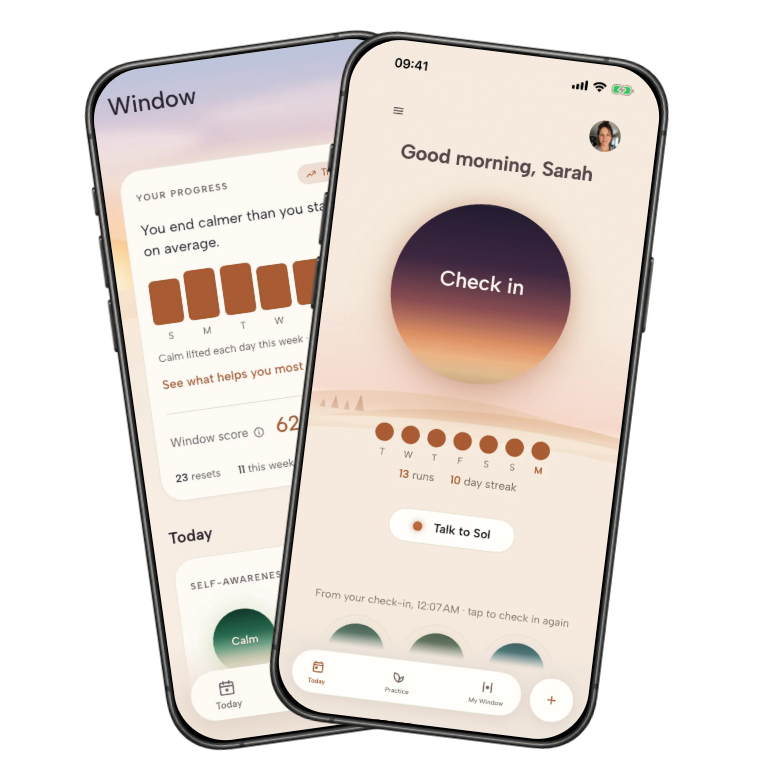
NerveWindow uses this same state-first logic. Instead of asking you to choose from a giant menu of practices, it helps you check your current pattern and pick a short matched routine for that moment.
That makes it different from a generic habit tracker or meditation library. The point is not to become permanently calm. The point is to get better at noticing state shifts earlier, choosing smaller interventions, and returning with less self-attack.
Safety note: self-guided regulation practice is not therapy, medical care, crisis care, or a replacement for qualified clinical support. If state shifts feel intense, trauma-linked, dangerous, or hard to recover from, work with a licensed professional or appropriate local support.
FAQ
What is the window of tolerance?
The window of tolerance is an educational model for the range where you have enough capacity to think, feel, and respond without becoming overwhelmed or shut down.
What does it mean to be above the window?
Above the window usually means your system is more activated: urgency, racing thoughts, shallow breathing, bracing, scanning, irritability, or a push to act quickly.
What does it mean to be below the window?
Below the window usually means your system has dropped into a lower-energy pattern: fog, numbness, heaviness, disconnection, task paralysis, or difficulty starting.
Can you widen your window of tolerance?
Many people use that phrase to mean building more capacity through repeated noticing, state-matched tools, recovery, and support. It is better to treat widening the window as practice, not a guaranteed treatment outcome.
NerveWindow helps you check your state and choose a short matched routine. $27 lifetime. 30-day refund.