Somatic journaling prompts: choose one gentle place to begin
Direct answer: choose whether you want to notice, name, or find one next step. The selector will show one bounded body-aware prompt without asking you to type or submit what you write.
What feels workable right now?
There is no best choice. Start with the lightest option that fits.
No account required. This page has no writing field. Aggregate interaction measurement follows your privacy choices.
Safety and scope
This is optional reflection, not a test or a reading of your nervous system. Skip any prompt or body focus that feels uncomfortable or more unsettling. Choose the non-writing option whenever writing does not feel useful. This tool is not emergency or medical support.
Look outward instead
Let your eyes move around the room and quietly name three neutral objects. Notice one color or straight edge on each. You do not need to explain how you feel.
Choose another kind of short practice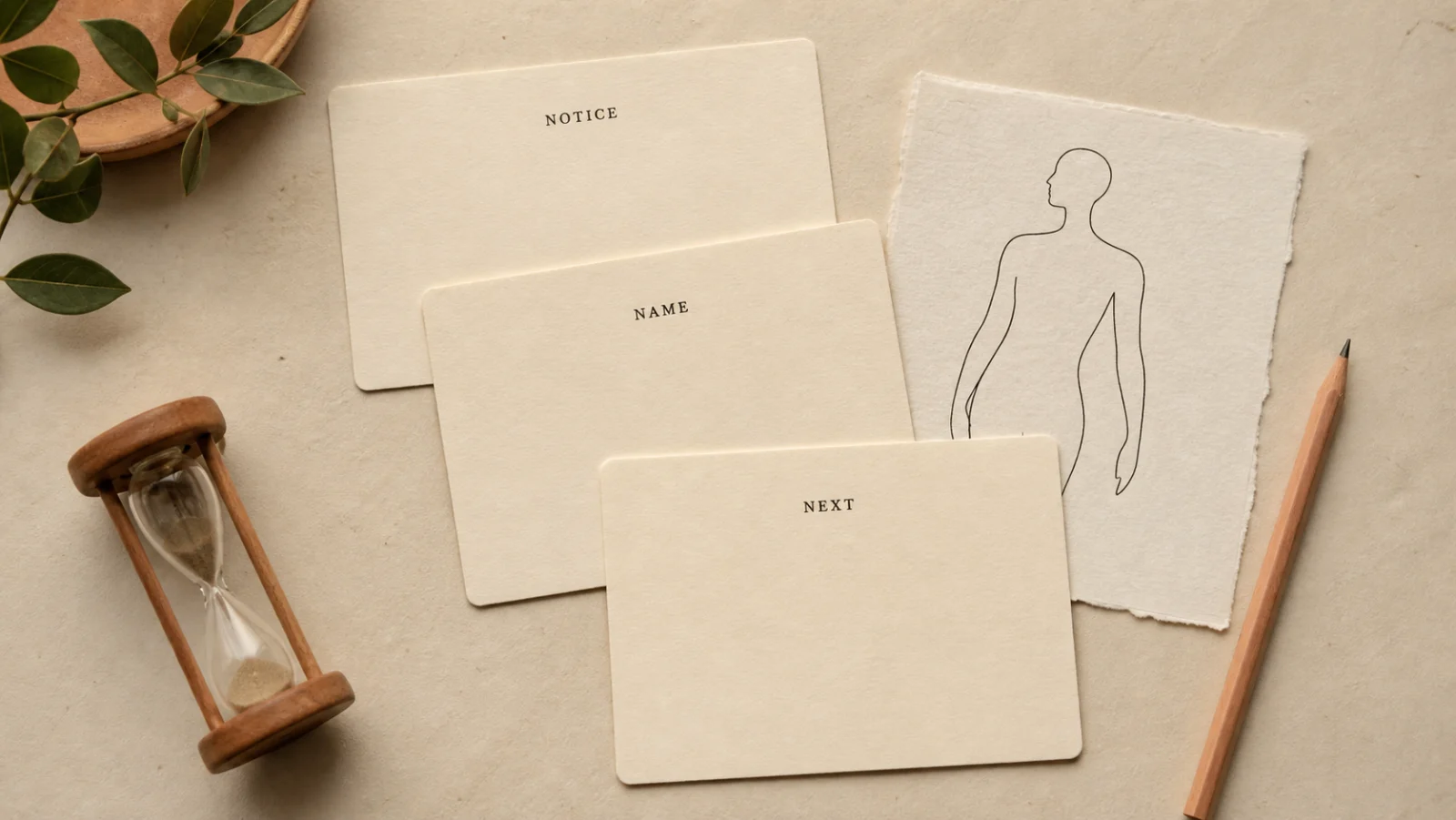
Body-aware, present-moment, and bounded
Somatic journaling can mean many things. On this page, it means using an ordinary present-moment body cue as one part of a short reflection. It does not mean searching for hidden memories, forcing an emotional release, or deciding what physiological state you are in.
The prompt is bounded on purpose. “Notice” stays descriptive. “Name” allows “not sure.” “Next” asks only about the next ten minutes. You can stop after a few sentences.
If you want the evidence-focused explanation rather than a prompt, read about interoceptive awareness and emotion regulation. That research used specific laboratory measures and does not prove this selector.
Research does not make every kind of writing equivalent
A 2002 study assigned 122 students to three writing conditions about stressful or traumatic events or media events. The conditions produced different reported effects. That is a reason to avoid presenting “journaling” as one uniform intervention, and it is not evidence that this tool creates a health outcome.
A 2007 laboratory study found different neural responses during affect labeling of negative images than during other encoding tasks. It tested a specific image-labeling task, not free-form journaling. For that distinction, see the separate guide to affect labeling.
A small EEG study of 28 participants reported an association between interoceptive awareness and reappraisal in its task. It did not show that body attention is always helpful. If inward attention feels uncomfortable, the outward-looking option above is the better route today.
Choose among more than one kind of practice
NerveWindow helps you choose among writing, movement, grounding, breathing, attention, and body-based options. Writing is one route, not the route you have to use.
Sources
These studies set evidence boundaries; none directly tests or validates this selector.
- Ullrich PM, Lutgendorf SK. Journaling about stressful events: effects of cognitive processing and emotional expression. Annals of Behavioral Medicine. 2002;24(3):244–250. doi:10.1207/S15324796ABM2403_10.
- Lieberman MD et al. Putting feelings into words: affect labeling disrupts amygdala activity in response to affective stimuli. Psychological Science. 2007;18(5):421–428. doi:10.1111/j.1467-9280.2007.01916.x.
- Füstös J et al. On the embodiment of emotion regulation: interoceptive awareness facilitates reappraisal. Social Cognitive and Affective Neuroscience. 2013;8(8):911–917. doi:10.1093/scan/nss089.

About Alex Zah
Alex Zah created NerveWindow and its state-matched self-guided practices. His NerveWindow product work includes short writing, movement, grounding, breathing, attention, and body-based options.